Reliability in digital signage is the ability to keep the approved program visible, accept controlled updates, expose faults, and recover without replacing unrelated hardware. A display’s internal system-on-chip and an external Media Player Box can both play scheduled content, but they place storage, software, networking, and service responsibility in different locations.
An internal platform reduces component count. A dedicated box separates the playback lifecycle from the panel. Neither arrangement is universally more reliable; the operating environment and maintenance model decide which failure boundary is preferable.
Compare the Hardware Replacement Boundary
With an internal system-on-chip, panel and player belong to one appliance. That simplicity suits installations with stable requirements and a display platform whose supported formats, applications, and update policy match the project. A Media Player Box creates a separate replaceable endpoint, allowing playback hardware to be serviced or upgraded without changing the panel.
Replacement planning includes more than the purchase price. A failed external unit may be exchanged while the panel remains installed, whereas an embedded platform can tie playback recovery to display service procedures and model availability.
The preferred boundary depends on spare strategy, access conditions, expected display life, and whether the organization standardizes one endpoint across several panel types. The extra device also adds a power supply, cable, and mounting requirement.
Reliability analysis should count those physical elements along with the benefit of independent replacement. Environmental conditions can change the result. A box hidden behind a display needs ventilation, strain relief, and accessible power, while an internal platform shares the thermal and power design of the panel.
Service access is part of reliability because an easily replaced component reduces the duration of a fault. A spare strategy can then target the component most likely to shorten recovery, whether that is a complete endpoint, its power adapter, storage media, or a prepared configuration package.
Define Storage and Offline Playback Behavior
Scheduled signage normally stores assets locally so network loss does not interrupt every frame. A Media Player Box offers a stated storage boundary that can be sized against bitrate, playlist duration, update frequency, and backup content.
An internal player may offer the same behavior, but capacity and file-management access vary by display platform. The acceptance test should disconnect the management network after content synchronization. Playback must continue from local storage, and the endpoint should reconnect without losing schedule state.
Storage health and remaining capacity also need visibility. A nearly full endpoint may receive small updates successfully and then fail on a larger campaign. Retention rules for obsolete assets keep the local library predictable without removing the fallback content required during a publishing error.
Match Outputs, Orientation, and Composition
Panel-integrated software naturally targets that panel’s display surface. External hardware becomes useful when landscape and portrait rotation, multiple windows, a downstream processor, or direct LED interfaces must be controlled explicitly. The Media Player Box needs sufficient decoding, output resolution, and composition capacity for the actual program rather than a single demonstration clip.
The KP4K-G from Kystar supports HDMI 2K/4K output, landscape and portrait rotation, mainstream video, image, audio, and text playback, multiple simultaneous video and image windows, cloud cluster management, and program editing through Kystar PE or the Pandora mobile workflow.
Examine Peripheral and LED Integration
Some signage endpoints must sense the environment, control power, or connect directly to LED modules. A Media Player Box can expose defined interfaces for these tasks independently of the panel electronics.
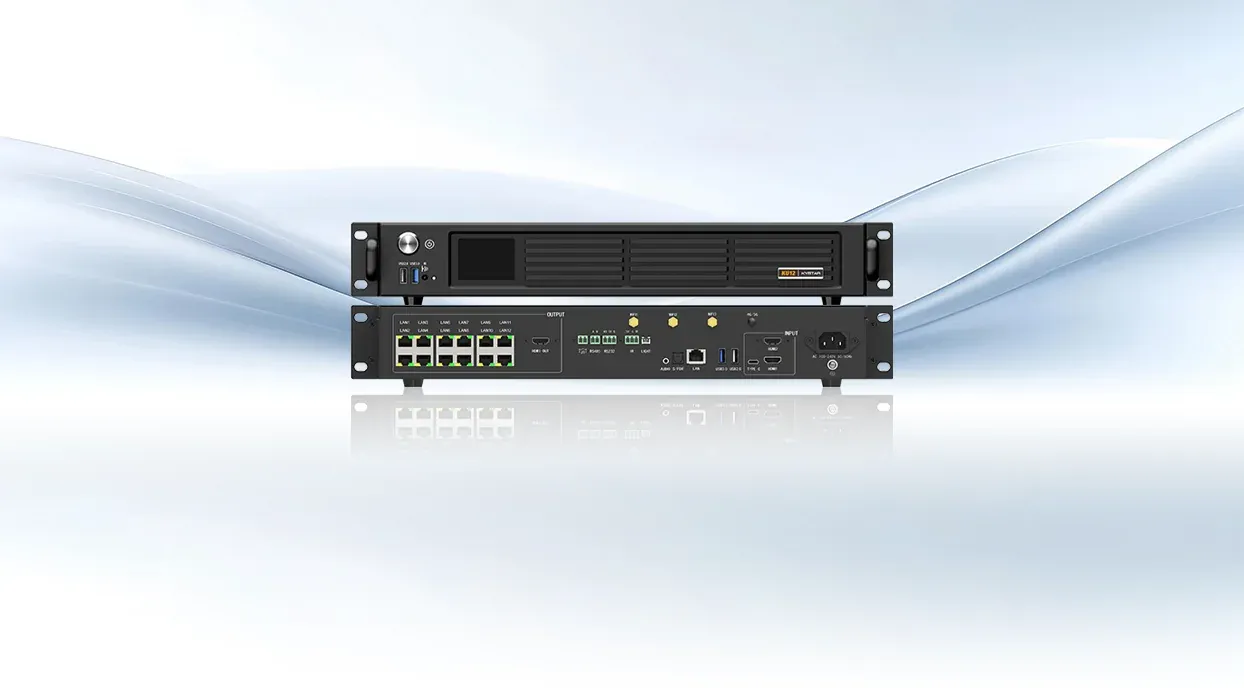
In KPB12, playback, sending, and receiving are integrated around 12 HUB-75E ports for direct module connection; the unit also provides 8 GB of storage with USB expansion, multiple communication options, sensor inputs, and relay control.
These features create additional engineering responsibilities. Sensor ranges, relay loads, module compatibility, cabling, and service access require verification; integration is reliable only when the attached functions are documented and tested.
Peripheral behavior after a restart deserves its own check. A relay should not toggle unexpectedly, brightness sensing should return to an approved range, and direct module outputs should reload the correct mapping before scheduled content resumes.
Judge Fleet Operation and Recovery
Reliability across many sites depends on visibility and permissions as much as local playback. A Media Player Box managed through Kares Cloud can support remote publishing, playback-status monitoring, scheduling, user authorization, batch brightness, volume, and power commands, and breakpoint resumption.
A system-on-chip fleet can be equally manageable if its platform exposes comparable controls consistently across the installed displays. Mixed panel generations complicate that consistency. An external endpoint can standardize playback and management across different screens, whereas an internal approach may require several application versions or feature subsets.
Conversely, a uniform fleet with long vendor support can preserve the simplicity of the embedded design. The decisive test follows a realistic incident: failed update, lost network, interrupted transfer, unauthorized change attempt, or endpoint restart.
The external approach is stronger when independent hardware, explicit interfaces, and one management layer improve recovery across mixed screens or LED products. The internal approach remains attractive when panel and software lifecycles are aligned and the required program stays within the display’s native capabilities.
A procurement record should therefore compare recovery time, update support, local storage, monitoring, physical service access, and the expected replacement cycle. Reliability is demonstrated by the maintained workflow, not by whether playback electronics sit inside or outside the panel.
