Five useful directions for a 2026 scheme are a clear landmark, a ride form that carries the theme, purposeful zone transitions, a defined evening scene and details that can be refreshed. Together, they give water park themes a role in both the visitor’s route and the development’s visual identity.
The ideas work at different scales within a single development. One concerns the skyline, another a transition between areas, and another a graphic encountered at walking pace. An investor can assign each a job before deciding how much decoration the scheme needs or which attraction will carry its principal identity.
- Let One Landmark Organise the View
A main landmark gives the eye a destination. A slide tower might read as a lookout, cliff, volcano or futuristic structure, depending on the concept. Supporting elements can then take quieter roles, so the main attraction remains recognisable within the wider setting.
In water park designs, that hierarchy can guide the relationship between tall structures, gateways and smaller details. The idea is applied by identifying what visitors see first and what they discover later. Every feature does not need the strongest colour or largest decorative form.
The selected hierarchy also gives water park themes a practical editing rule. A proposed addition can be assessed by whether it supports the main landmark or competes with it. A repeated shape may connect the areas more effectively than another large object demanding attention.
- Make the Ride Form Part of the Concept
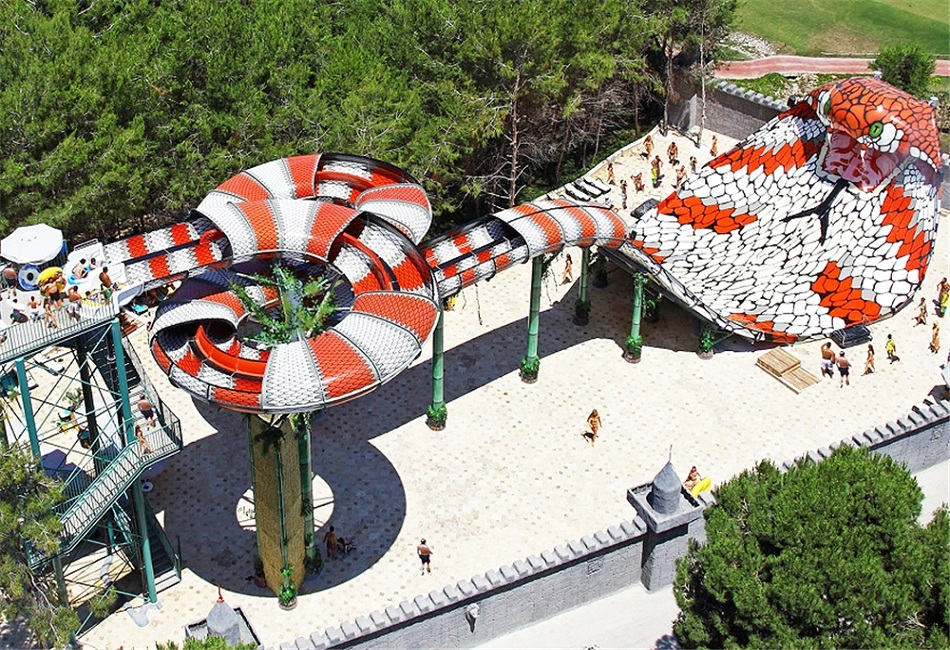
An attraction can carry an identity through its own outline and movement. Jinchao’s Cobra Water Slide combines a snake-shaped visual form with dark tunnel sections and LED light bands. Its two-rider configuration has a 1.4 m flume and a 15 m starting height.
The Flower Slide offers a different external form and a two-person raft, with a 1.4 m flume. Changes of slope and buffer sections shape the ride. These examples connect appearance with a particular attraction, rather than treating an unrelated decorative object as the entire concept.
A water park manufacturer developing the scheme can coordinate flume colours, tower silhouette and entrance treatment with that chosen identity. The useful design question concerns how the external form and the rider’s experience express the same idea at different moments.
The themed proposal draws on Jinchao’s custom-design service. Production uses an approximately 36,000 m² manufacturing base within a business reporting more than 300 projects. The agreed drawings can identify the equipment and visual details being purchased, giving the theme a defined scope within that business.
- Give Transitions a Recognisable Purpose
Moving between zones can become part of the experience. A gateway, a change in paving, planting or a consistent sign family can indicate that the setting is changing. The transition has a clearer role when it introduces the next area and remains easy to follow.
Such connections allow water park designs to contain variety without becoming a set of unrelated scenes. The principal landmark may remain visible while the nearby details change. A route can therefore introduce a new character without abandoning the visual relationships that orient visitors.
The transition drawing can bring the entrance, adjacent path and next destination together. A themed gateway still has to accommodate movement through it. The concept develops through the sequence of arrival and departure, with decorative treatment attached to a location and a purpose.
- Plan an Evening Scene with a Defined Attraction
Evening presentation brings an attraction, viewing position and operating schedule together. At night, Jinchao‘s Sky Ring Slide pairs lighting with water-screen projection. The attraction has a published 12–15 m starting-height range, tying the proposed scene to a defined ride concept.
For a water park manufacturer, the discussion can distinguish the ride’s physical arrangement from the desired scene around it. An effect does not establish the opening hours, audience size or financial result. Those remain separate planning questions for the venue.
Evening views can also reveal a different hierarchy within water park designs. The selected landmark may become a focus while supporting areas remain visually quieter. Defining that relationship before choosing individual effects keeps the scene connected to the park’s identity and the spaces from which it will be seen.
- Keep the Identity while Refreshing the Detail
Selected graphics, panels and lighting scenes can be renewed around the main forms and colour relationships that establish the identity. Treating those as different layers gives future updates a defined scope. A seasonal alteration can then add variety without requiring a new structural identity for the attraction.
Jinchao develops customised theme directions and equipment details around the project. For the water park manufacturer, the brief can separate permanent elements from the details planned for later replacement. The scheme for water park themes can record both layers, including access to the parts receiving routine attention.
Changes can also be checked against the way visitors recognise a destination. A new seasonal graphic may be temporary, but the entrance it marks remains a working location. Keeping that relationship legible allows the refreshed detail to sit within the established route and the continuing attraction identity.
Across the five ideas, the design task moves between the scale of a landmark and the treatment of individual details. Each proposed element earns its place by contributing orientation, experience or a planned opportunity for renewal. The design brief can identify which of those jobs the next addition must perform.
